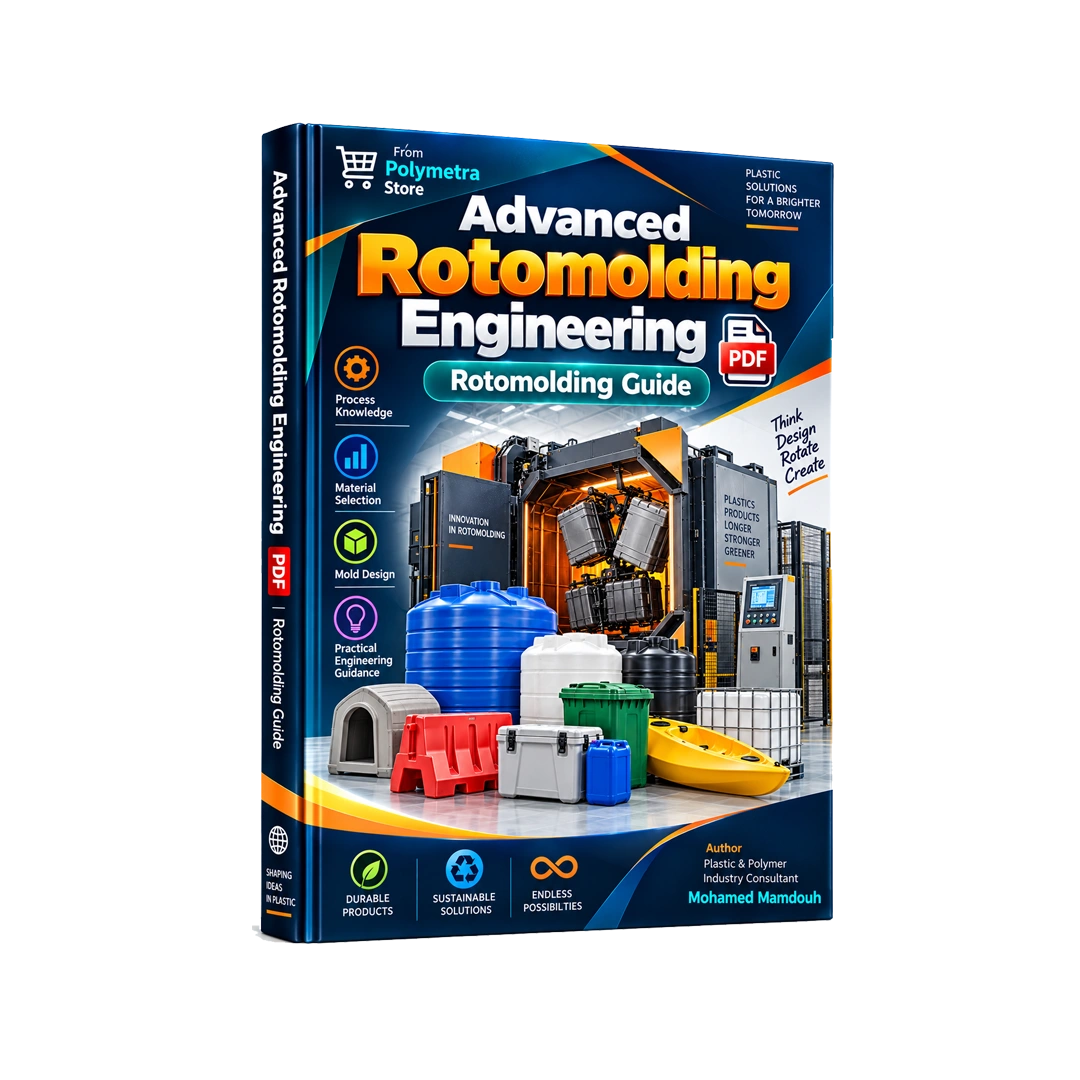
Advanced Rotomolding Engineering PDF | Complete Guide to Rotational Molding
The Complete Industrial Guide to Manufacturing Hollow Plastic Products with High Quality and Lower Production Cost
Advanced Rotomolding Engineering is a specialized technical reference for professionals working with Rotational Molding (Rotomolding) and the manufacturing of large hollow plastic products.
Rotomolding is a unique plastic processing technology used to manufacture products such as water tanks, chemical containers, industrial storage products, waste bins, fuel tanks, toys, kayaks, and many other hollow plastic products. Unlike injection molding, the process does not depend on high injection pressure; instead, it relies on the controlled interaction of heat, time, biaxial rotation, polymer behavior, mold design, and cooling.
Although the basic principle may appear simple, achieving stable production and consistent product quality requires considerably deeper technical knowledge.
This book was created as a practical engineering reference for understanding the complete rotational molding production environment—from material selection and mold design to process control, quality testing, troubleshooting, cost reduction, maintenance, and equipment performance.
A Professional Rotomolding Engineering Reference
The quality of a rotationally molded product is influenced by numerous interconnected factors.
Raw material selection, powder characteristics, mold geometry, heating conditions, rotational speed, rotation ratio, cooling, venting, and demolding can all influence the final product.
The book approaches Rotomolding as an integrated engineering process rather than simply a machine operation.
It explains the relationship between:
Raw Materials → Mold Design → Heating → Rotation → Fusion → Cooling → Quality Control → Cost → Productivity
This approach is particularly valuable for engineers and production professionals who need to understand why production problems occur and how the different elements of the process interact.
Understand the Rotational Molding Process
The book begins by establishing a solid engineering foundation for Rotomolding.
Readers are introduced to the fundamental production cycle, including raw-material loading, heating, melting and material distribution, cooling, mold opening, and product removal.
It also explains why rotational molding differs from other plastic processing technologies and where the process is particularly suitable.
One of the important characteristics discussed is the ability to manufacture very large hollow products, including tanks with capacities of 20,000 liters and more, while benefiting from relatively low mold costs and the absence of weld lines in the molded structure.
Rotomolding Machines & Equipment
Choosing the right machine is an important part of establishing or developing a rotational molding factory.
The book covers major rotational molding machine configurations, including:
- Carousel Machines
- Shuttle Machines
- Rock & Roll Machines
- Different heating systems
- Process-monitoring technologies
- PLC control
- Temperature monitoring
- PIAT measurement
- Cooling systems
- Energy-management technologies
The reference also discusses the relationship between machine selection, product size, production volume, factory space, investment budget, flexibility, and energy consumption.
This makes the book useful not only for machine operators, but also for people involved in factory planning and equipment selection.
Raw Materials & Polymer Behavior
Material selection is one of the most important parts of successful rotational molding.
The book places particular attention on Polyethylene (PE) and its different grades used in Rotomolding, together with powder characteristics and polymer behavior during heating and fusion.
Topics include:
- LLDPE
- MDPE
- HDPE
- Rotomolding powder characteristics
- Particle size
- Bulk density
- Melt Flow Index
- Polymer behavior during heating
- Particle sintering
- Fusion
- Additives
- Pigments and masterbatch
- UV stabilization
- Antioxidants
- Antistatic systems
- Raw-material testing
The reference emphasizes that raw material should be evaluated as a complete specification rather than relying on a single parameter such as MFI.
This section is particularly valuable for factories seeking to improve material consistency, product performance, and process stability.
Rotomolding Mold Design
Mold design has a direct relationship with product quality, thermal behavior, cycle time, dimensional stability, and wall-thickness distribution.
The book provides a dedicated engineering treatment of rotational molding molds, including:
- Mold construction
- Aluminum molds
- Fabricated steel molds
- Mold wall thickness
- Venting
- Corners and transitions
- Wall-thickness calculations
- Shrinkage
- Surface finish
- Material distribution
- Mold orientation
- Thermal uniformity
- Common mold-design errors
- Modern mold-design concepts
A well-designed mold is presented as an important part of achieving a combination of uniform product quality, efficient thermal cycles, and reduced scrap.
Production Process Control
One of the strongest aspects of the book is its focus on process control.
Rotational molding is highly dependent on the interaction between:
Heat + Time + Rotation + Material + Mold
The book examines the production cycle from charging the mold through heating, melting, material distribution, cooling, and demolding.
Particular attention is given to PIAT — Peak Internal Air Temperature, rotational-speed ratios, heating conditions, cooling control, and cycle-time optimization.
These concepts are important for manufacturers attempting to achieve repeatable production instead of relying on trial-and-error adjustments.
Quality Control & Laboratory Testing
Quality control receives a dedicated chapter because many rotational molding defects cannot be reliably identified through visual inspection alone.
The book discusses professional quality-control considerations including:
- Wall-thickness measurement
- Impact resistance
- ESCR
- UV resistance
- MFI
- Density
- Failure analysis
- Internal voids
- Product testing
- Production traceability
- Quality-control planning
- Production KPIs
The reference specifically highlights measurements such as wall-thickness variation, production yield, scrap rate, energy consumption, downtime, cycle time, and material consumption as useful indicators of factory performance.
Troubleshooting & Defect Diagnosis
Production defects are one of the most valuable areas for engineers and technicians.
The book develops a structured approach based on:
Diagnosis → Root Cause → Corrective Action → Preventive Action
It addresses common rotational molding problems such as:
- Air bubbles
- Voids
- Burn marks
- Thermal degradation
- Wall-thickness variation
- Warpage
- Distortion
- Pinholes
- Poor impact resistance
- Product sticking
- Shrinkage problems
- Surface defects
- Dimensional problems
It also distinguishes between operating/process defects and design-related defects, helping readers approach troubleshooting more systematically rather than changing machine settings randomly.
Cost Reduction & Production Efficiency
Rotomolding profitability is not determined by product selling price alone.
Production cost is affected by:
- Raw material consumption
- Scrap
- Energy consumption
- Cycle time
- Machine utilization
- Maintenance
- Production efficiency
- Product quality
- Downtime
The book includes a dedicated section on cost calculation, scrap reduction, energy consumption, productivity, and break-even analysis. Its approach connects technical production performance with factory economics.
This makes the book particularly relevant to factory owners, production managers, investors, and engineers responsible for manufacturing costs.
Modern Rotomolding Technology
The book also looks beyond traditional Rotomolding.
It discusses the direction of modern rotational molding toward:
- Advanced materials
- Multilayer products
- Recycled materials
- Lightweight structures
- Automation
- Digital process monitoring
- Data-driven manufacturing
- Energy-efficient equipment
- Smart process control
- Advanced product design
The book describes the future rotational molding factory as an integrated system combining materials, mold design, process control, energy management, quality control, and data analysis.
Mechanical, Electrical & Preventive Maintenance
A rotational molding factory cannot maintain stable production without reliable equipment.
The later chapters extend beyond production technology into:
- Mechanical maintenance
- Electrical maintenance
- Preventive maintenance
- Equipment failure reduction
- Machine-life extension
- Condition monitoring
- Recurring-failure analysis
- Maintenance indicators
The maintenance approach combines scheduled maintenance with operating-hour maintenance and condition monitoring, providing a more structured strategy for maintaining rotational molding equipment.
Who Is This Book For?
Advanced Rotomolding Engineering PDF is designed for:
- Rotomolding engineers
- Process engineers
- Production engineers
- Factory managers
- Rotational molding technicians
- Plastic factory owners
- Production managers
- Quality-control engineers
- Maintenance engineers
- Plastic industry investors
- Entrepreneurs establishing Rotomolding factories
- Professionals seeking advanced rotational molding knowledge
The book itself identifies process engineers, factory managers, new investors, and production-line owners as key readers.
What Makes This Reference Valuable?
The strength of Advanced Rotomolding Engineering is that it connects several areas that are often treated separately:
Materials + Machines + Molds + Process + Quality + Troubleshooting + Cost + Maintenance
Instead of studying each subject independently, the reader can develop a broader understanding of how these elements interact inside a real Rotomolding factory.
It is therefore suitable as a professional technical reference for daily factory use, technical training, production improvement, and industrial project development.
About the Author
Mohamed Mamdouh is a plastics industry specialist with more than 30 years of practical experience in injection molding, extrusion, plastic film production, and polymer recycling.
The book states that his professional experience includes participating in the development, commissioning, and operation of plastic production lines, with a practical focus on production optimization, quality improvement, material utilization, waste reduction, and manufacturing efficiency.
Advanced Rotomolding Engineering PDF
If you work with Rotational Molding, manufacture hollow plastic products, operate a Rotomolding production line, or are planning to establish a rotational molding factory, this reference provides a concentrated source of technical and industrial knowledge.
Learn the engineering behind Rotomolding. Understand the relationship between materials, machines, molds and process control. Improve production decisions. Reduce unnecessary losses. Build more consistent manufacturing performance.
Advanced Rotomolding Engineering
The Complete Guide to Manufacturing Hollow Plastic Products with High Quality and Lower Cost
99 Pages | 16 Chapters | Professional PDF Reference
🛒 How to Purchase from Polymetra Store
You can purchase engineering books and courses from Polymetra Store from anywhere in the world easily and securely.
1️⃣ Create an Account
Create a free account using your email address to save your purchases and access them later.
2️⃣ Choose Your Product
Select the book or course you want, click Add to Cart, and proceed to checkout.
3️⃣ Choose Your Payment Method
🇪🇬 Inside Egypt:
✔ Visa
✔ Mastercard
✔ Apple Pay for supported cards
🌍 Outside Egypt:
✔ Visa
✔ Mastercard
✔ Apple Pay where available
✔ Supported local and international bank cards
✔ Other payment methods available through the payment gateway, depending on your country
💱 Pay in Your Local Currency
Product prices are displayed in Egyptian Pounds (EGP). When paying from outside Egypt, your bank or payment provider may convert the transaction amount into your local currency according to its applicable exchange rate and fees.
📥 Instant Download
After successful payment:
✔ Your order is confirmed automatically.
✔ The product is added to your account.
✔ You can download your book or course immediately.
♾️ Access Your Purchases
Access your purchases from your phone, desktop, laptop, or tablet from anywhere in the world, with the ability to download them again according to the product's applicable policy.
🔄 Updates
Products eligible for updates will receive new editions or updated versions without requiring you to purchase the product again.
🌍 Available Worldwide
Polymetra Store is available to customers worldwide. You can register and purchase from anywhere using the payment methods available in your country.
🔐 Secure Payment & Technical Support
Payments are processed through secure electronic payment gateways. If you experience any issue with registration, payment, or downloading, please contact us:
📱 WhatsApp: 01158565011
📱 International: 00201158565011
📧 Email: info@pollymetra.com
🚀 Get Started
Create an account → Choose your product → Pay with your preferred method → Download your purchase instantly.
Polymetra — Your specialized engineering library for the plastics and polymers industry.
FAQ – Advanced Rotomolding Engineering PDF
What is this book about?
A specialized engineering reference covering Rotational Molding (Rotomolding), from materials and molds to process control, quality, troubleshooting, maintenance, and cost reduction.
How many pages is the book?
The book contains 99 pages across 16 chapters.
What materials are covered?
The book focuses primarily on Polyethylene (PE) and discusses LLDPE, MDPE, HDPE, powder characteristics, additives, pigments, UV stabilizers, and material testing.
Does the book cover Rotomolding machines?
Yes. It covers major machine configurations, heating and cooling systems, PLC control, temperature monitoring, PIAT measurement, and process monitoring.
Does it cover mold design?
Yes. The book covers Rotomolding mold construction, venting, shrinkage, wall thickness, thermal behavior, material distribution, and mold design considerations.
Does it explain process control?
Yes. It covers the relationship between heat, time, rotation, material, and mold, including PIAT, rotational speed, cooling, and cycle-time optimization.
Does the book cover defects and troubleshooting?
Yes. It addresses common Rotomolding defects and provides a structured approach to diagnosis, root-cause analysis, corrective action, and prevention.
Does it cover quality control?
Yes. Topics include wall thickness, impact resistance, ESCR, UV resistance, MFI, density, product testing, scrap rate, cycle time, and production KPIs.
Does it cover cost reduction?
Yes. The book addresses material consumption, scrap reduction, energy use, cycle time, productivity, machine utilization, and break-even considerations.
Who is this book for?
It is suitable for Rotomolding engineers, production engineers, technicians, factory managers, plastic manufacturers, investors, and entrepreneurs planning Rotomolding projects.
Is the book available as a PDF?
Yes. It is available as a digital PDF reference.
Can I purchase it from anywhere in the world?
Yes. Polymetra Store is available worldwide, subject to the payment methods supported in your country.
#Rotomolding #RotationalMolding #PlasticManufacturing #PolymerEngineering #PlasticProcessing
لا يوجد تقييمات حتى الآن
?????
PDF
??? ???????
99
منتجات ذات صلة
منتجات مختارة خصيصًا لك
كتاب صناعة القوارب والهياكل البحرية | الدليل العملي PDF - EN
خصم 4%
وفّرت 24 EGP
576
EGP
بدلاً من
600 EGP
سعر مخفّض — اغتنم العرض